Skip to content

March 17 Barry’s Café The Next Chapter – Partnering

Our goal is to broaden the reach of the Africa Bridge model “The 5-Year path prosperity”. Our strategy is to partner with other organizations seeking to improve the wellbeing of vulnerable populations in rural Africa. This participant lead dialog will explore this arrangement where two parties cooperate in order to advance their mutual interests.

The goal of the 45-minute dialogs (Barry’s Café) is to deepen our relationships with supporters, donors and fellow implementers. The format of Barry’s Café conversations will be focused on a specific topic and conducted as a Q & A dialog. You are welcome to as questions during the event. Send in your questions early to sharon@africabridge.org

This event will not be recorded, so register using the link below:

https://us02web.zoom.us/webinar/register/WN_e1fwv4BOTn6IO4TF4w-g4A

International Women’s Day

As we celebrate International Women’s Day, please read Alice’s Story of Resilience and Transformation. Alice is 54 years old and a farmer by profession. When Africa Bridge began implementing its project activities in the Isongole Ward (Idweli Village), Alice’s household was identified as one of the families caring for Most Vulnerable Children. She is a widow and was raising five children—four boys and one girl—on her own.
Before the participating in the co-op program of Africa Bridge, Alice mainly cultivated potatoes for both consumption and sale. However, the income she earned from selling potatoes was not sufficient to meet her family’s needs. Most of the money was used to cover small school expenses for her children, and only a small portion was allocated to daily household necessities.
Reflecting on her situation, Alice shared:
“My husband was a hard worker; he used to provide for many of our family’s needs. After he passed away, life became much more difficult for me because I had to take care of all five children by myself. We only had a small plot of land for cultivating potatoes, which was not enough to support our family. Potato farming is also seasonal and subject to price fluctuations—sometimes you make a profit, and sometimes you incur a loss.”
She decided to join the cooperative because she already had experience in potato farming. Through the project, Africa Bridge supported the group to rent and expand farmland. As a result, Alice increased her cultivated land from half an acre to one and a half acres.
During the first phase of the potato project, most cooperative members did not benefit because the crops dried up in the fields. Despite this setback, Alice and her fellow cooperative members did not give up. They decided to try the following season again—and this time, their efforts paid off. The potatoes thrived, resulting in a good harvest. From that point on, Alice began to experience a real transformation in her family’s life.
With the income she earned from selling potatoes, Alice made significant improvements to her home. She replaced the mud floor with a cement floor, improved school support for her children, built a proper toilet, purchased modern furniture, and a television and radio.
Over time, the project enabled her to move from renting farmland to purchasing her own plot. She also diversified her income by investing in livestock and now keeps pigs and chickens.
Today, Alice lives with one grandchild, as all her children have grown up, established their own homes, and are now self-reliant. They also support and care for her. She concludes with gratitude:
“I thank Africa Bridge because at a time when life seemed impossible for my family, they gave me hope and showed me that it was still possible to move forward.”

Africa Bridge is conducting a series of webinars and dialogs during 2026

The goal of the 45-to-60-minute formal webinars is to engage people interested in topics concerning wildlife, social and economic development in Africa. The format is a short “show and tell” about how Africa Bridge impacts these issues followed by a panel discussion with invited guests extending the specific webinar topic.

The goal of the 45-minute dialogs (Barry’s Café) is to deepen our relationships with supporters, donors and fellow implementers. The format of Barry’s Café conversations will be focused on a specific topic and conducted as a Q & A dialog.

March 17 Barry’s Café

“The Next Chapter” Partnering

Our goal is to broaden the reach of the Africa Bridge model “The 5-Year path prosperity”. Our strategy is to partner with other organizations seeking to improve the wellbeing of vulnerable populations in rural Africa. This participant lead dialog will explore this arrangement where two parties cooperate in order to advance their mutual interests.

Register using the link below:

https://us02web.zoom.us/webinar/register/WN_e1fwv4BOTn6IO4TF4w-g4A

April 9 Webinar

“The Paradox” Conserving Africa’s Wildlife by Empowering People

On the one hand African wildlife is under threat, the populations have declined 76% over the last 50 years. On the other 70% of the population is under 30. Youth unemployment can be as high as 58%. Are we forced to choose between conservation or economic development? It is impossible to conserve wildlife effectively without ensuring the wellbeing of the local people. The barrier to achieving this goal is extreme poverty. 90% of those living in extreme poverty (subsisting on less than $2.00 per day) reside in Sub-Saharan Africa, 80% live in rural areas and 50% are children. The incapacitating impacts created by extreme poverty, is a threat to wildlife and a limitation on creating income opportunities for local people.

Panel: To be announced

Register using the link below:

https://us02web.zoom.us/webinar/register/WN_xSyawcX0T9qdF4elAqigjQ

May 19 Barry’s Café

“Wildlife” Taking the high road

An exploration as to why wildlife conservation matters to the immediate neighbors and to the world at large. Exploring the ethics of wildlife conservation and assessing whether conservation is a cost or an asset?

Special Guest: Debbie Ethell

Register using the link below:

https://us02web.zoom.us/webinar/register/WN_YSvhhDLHQlmEDVMfXlgYxA

June 9 Webinar

“Breaking the Poverty Barrier” Following a path to prosperity

The realities of living in extreme poverty are grim. The incapacitating impacts created by extreme poverty are a threat the environment and to the future of those afflicted by it. An examination of how do we alleviate extreme poverty in rural African communities?

Panel: To be announced.

Register using the link below:

https://us02web.zoom.us/webinar/register/WN_tMh4EQXCTsCoQFnfPWGsqg

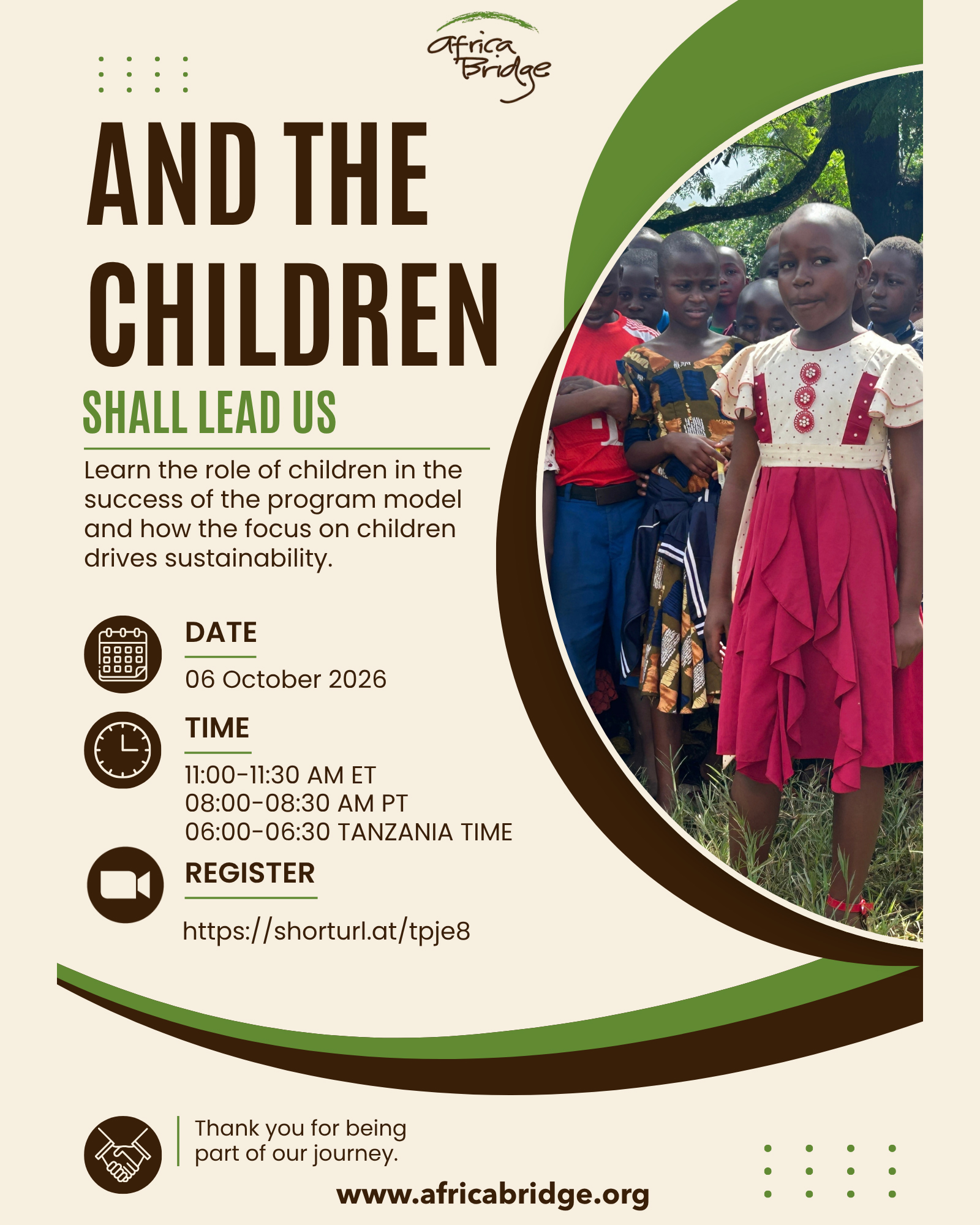
August 18 Barry’s Café                                                                                                                                                                                                                       “And the Children Shall Lead Us”

A discussion about Barry’s book with the above title, available at Amazon and Barnes and Noble. Please read the book before attending this café

Special Guest: Phillip Whitely

Register using the link below:

https://us02web.zoom.us/webinar/register/WN_vXI8XFodTH6Dt-V0pMVq2Q

October 22 Webinar

“Strong Family” The key to sustainable community development in Africa

There are two key strengths in rural African communities on which Africa Bridge builds a pathway for families to achieve sustainable prosperity. An inherent understanding of subsistence agriculture and the strength of the family. We will explore how effective economic development project impacts families and in particular women and how women ensure the sustainability of the projects. In the process we will hear about a few case studies.

Panel:  To be announced.

Register using the link below:

https://us02web.zoom.us/webinar/register/WN_miLkk4fYTEWgdC77a0k_TQ

November 17 Barry’s Café

“Love is a Verb” A source of joy over attainment

The word love has many meanings. The ancient Greeks had four words for love: eros (romantic, sexual love), storge (family love), philia (bonding with someone of similar beliefs) and agape (altruism, empathy and a love of humanity). When we define love as an act of completing another. Love can be applied to any activity one participates in whether it be with one’s partner, child, relative, friend, colleague, subordinate or ones God.  Love can give one the capacity to take on seemingly impossible tasks.

Register using the link below:

https://us02web.zoom.us/webinar/register/WN_m4gXBXtvQG2HjOLfLGMjGQ

Webinar & Café Registrations

Each event will be live on Zoom.  To receive a link to register please contact sharon@africabridge.org if you are unable to use the link in this post.

Start time for each event will be:

8 AM Portland, Oregon
11 AM NY Time
4 PM UK
6 PM East Africa

Conserving Wildlife by Empowering People

Tanzania’s Tarangire-Manyara Wildlife Corridor is one of the few remaining wildlife corridors in Eastern Africa, allowing for the free movement of large animals such as giraffe, elephants, zebras and buffalo between the Tarangire and Ngorongoro National Parks to the North, which is crucial for their survival.  The corridor is also a crucial giraffe nursery.

Yet the long-term sustainability of wildlife that rely on this corridor is not possible without assuring the wellbeing of communities living within it, including 12 villages in and around Manyara Ranch in this corridor. Today most of the community members in live in extreme poverty, threatening their own survival and the delicate balance between people and wildlife.

Families living around Manyara Ranch within this corridor often face an impossible choice: feed their children today, or protect the wildlife and land that will sustain them tomorrow. When crops fail and pastures dry, desperation drives parents into wildlife corridors—clearing land, grazing cattle, or hunting bushmeat—sacrificing long-term survival for short-term relief. The cost is devastating: dwindling wildlife, persistent poverty, and the erosion of one of Africa’s most vital ecosystems.

But a new path is opening. For 25 years, Africa Bridge has shown that rural communities can rise from extreme poverty without sacrificing their natural heritage. Now, in partnership with the community-led Manyara Ranch Management Trust, we are bringing this proven model to the Tarangire-Manyara Wildlife Corridor—22,000 square kilometers of grassland that sustains both iconic species and local livelihoods. With the ranch transferred to community stewardship in 2024, families now hold the keys to a shared future where prosperity and wildlife conservation go hand in hand.

Over the next five years, this partnership will demonstrate that thriving communities and thriving wildlife are not opposing goals, but inseparable ones. Together, we can replace the cycle of poverty and loss with a cycle of hope, resilience, and lasting abundance.

Walk With Us!

Join us in 2026 in Northern Tanzania!